
An Illustrated Guide to Shifting, Stretching, and Reflecting Function Graphs
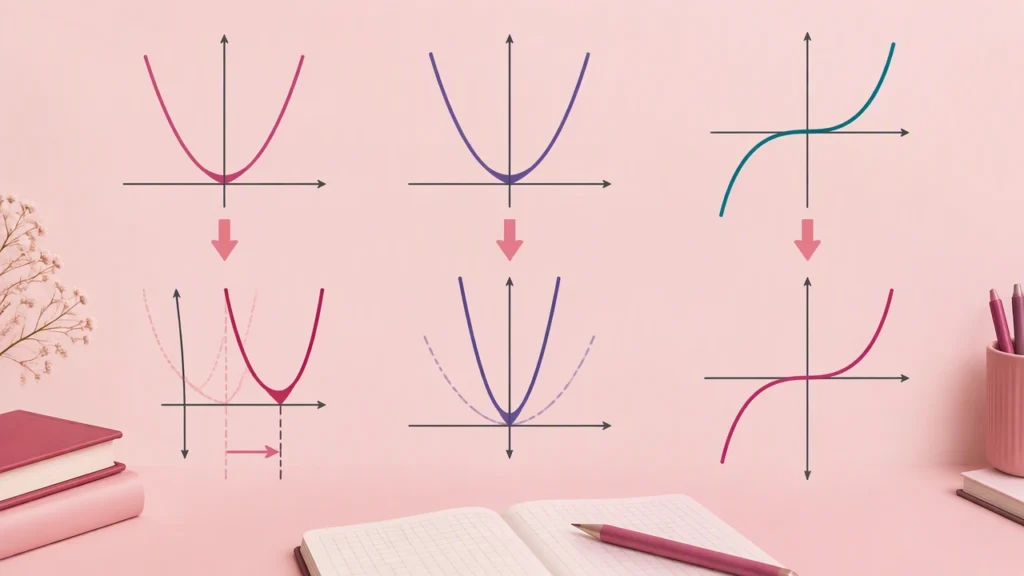
Most complicated-looking graphs begin as simple parent functions. Once you understand math functions as movable, resizable shapes, you can predict how a new equation will look before plotting a single point. This illustrated guide to function transformations translations stretches and reflections explained shows how shifting, stretching, and reflecting a parent function changes its graph predictably.
Start with a parent function
A parent function is the simplest form in a family of functions. The parabola y = x², the line y = x, and the curve y = |x| are familiar examples. Each has a recognizable shape and a standard position on the coordinate plane.
Transformations alter that shape or position without changing the basic family. A translated parabola is still a parabola. A vertically stretched absolute-value graph still has its characteristic V. The goal is to read the equation as a set of instructions for moving or reshaping the original graph.
Read transformations as instructions
Compare a parent function y = f(x) with two common modified forms:
- y = f(x − h) + k shifts the graph h units horizontally and k units vertically.
- y = a · f(x) stretches or compresses the graph vertically by the factor a, and reflects it when a is negative.
The key is to identify what is applied directly to the function and what is applied to the input x. Changes outside f act vertically. Changes inside f act horizontally, often in the opposite direction from the sign in the equation.
Translations: sliding a graph without changing its shape
Vertical translation
For y = f(x) + k, every output value increases by k. If k is positive, the graph moves upward; if k is negative, it moves downward.
Start with y = x². The graph of y = x² + 3 keeps the same width and vertex shape, but each point rises by three units. The vertex moves from (0, 0) to (0, 3). Because the shift is vertical, x-values stay the same while y-values change.
Horizontal translation
For y = f(x − h), the graph moves h units to the right when h is positive, and to the left when h is negative. This rightward movement for a minus sign often feels counterintuitive.
Consider y = (x − 2)². To reproduce the parent output at x = 0, the new input must be 2, because 2 − 2 = 0. The whole parabola therefore slides two units right, placing its vertex at (2, 0). In y = (x + 4)², the graph moves four units left.
Reflections: flipping a graph across an axis
Reflection across the x-axis
In y = −f(x), every output changes sign. Positive values become negative and negative values become positive, so the graph flips vertically across the x-axis. The x-intercepts stay where they are because zero remains zero.
For example, y = −x² opens downward instead of upward. Its vertex remains at the origin, but every other point is mirrored above or below the x-axis.
Reflection across the y-axis
In y = f(−x), the input changes sign before the function is evaluated. The graph mirrors horizontally across the y-axis.
The parabola y = x² looks unchanged after this reflection because it is symmetric about the y-axis. A less symmetric function makes the effect clearer: reflecting y = x³ gives y = (−x)³ = −x³, producing a graph rotated visually into the opposite orientation through a y-axis flip.
Stretches and compressions: changing the graph’s scale
Vertical stretch and compression
In y = a · f(x), multiply every output by a. When |a| > 1, the graph stretches vertically and appears narrower. When 0 < |a| < 1, it compresses vertically and appears wider.
Compare y = x² with y = 3x². At x = 2, the parent output is 4, while the transformed output is 12. The graph climbs faster, creating a narrower parabola. For y = ½x², the output at x = 2 is only 2, so the parabola rises more slowly and looks wider.
If a is negative, combine the vertical stretch or compression with a reflection across the x-axis.
Horizontal stretch and compression
In y = f(bx), the input is multiplied by b before evaluation. When |b| > 1, the graph compresses horizontally. When 0 < |b| < 1, it stretches horizontally.
For y = (2x)² = 4x², the graph reaches each parent height at half the x-value, so it appears horizontally compressed. For y = (½x)² = ¼x², it needs twice the x-value to reach the same height, so it appears horizontally stretched. A negative b also reflects the graph across the y-axis.
A reliable order of operations
When several transformations appear together, apply them in a consistent order:
- Identify the parent function and sketch its basic shape.
- Handle reflections caused by negative signs inside or outside the function.
- Apply stretches and compressions using the multiplication factors.
- Finish with translations, shifting the transformed graph horizontally and vertically.
This order prevents a common mistake: moving a graph first and then trying to stretch it around the wrong center. Reflections and stretches act around the current axes or origin; translations relocate the finished shape.
Work an example step by step
Take the parent function y = x² and transform it into y = −2(x + 3)² + 1.
- Reflect: the leading negative sign flips the parabola across the x-axis, so it opens downward.
- Stretch: the factor 2 makes it vertically narrower because outputs are doubled in magnitude.
- Shift left: the +3 inside the squared term moves the graph three units left.
- Shift up: the +1 outside moves it one unit up.
The vertex ends at (−3, 1). Instead of plotting many unrelated points, you can anchor the graph at the transformed vertex and use the reflected, stretched shape to complete it.
Why predictability matters
Function transformations connect algebra and geometry. A single equation becomes a short sequence of visual instructions: slide, flip, resize, then slide again. With practice, you will recognize those instructions immediately, sketch graphs more accurately, and understand how changes in a formula produce changes on the coordinate plane.