Math Functions Complete Beginners Guide: Definitions, Notation, Types, and Real Uses

Math functions are the basic building blocks of algebra, calculus, and modeling. If you have ever asked what are math functions and how do they work, this guide will walk you through the idea from the ground up. A function is a rule that takes inputs and returns outputs in a predictable way. Once you see the pattern, you can use functions to describe motion, growth, cost, probability, and many other ideas.
This pillar page focuses on clarity. We will move in plain steps, connect each concept to a simple example, and build a toolkit you can reuse. The goal is not to rush through formulas. The goal is to understand what a function does, how to write it, how to read it, and how to choose the right type for a problem.
What is a function in mathematics
A function is a relation that assigns exactly one output to each allowed input. The allowed inputs form the domain. The outputs form the range. Think of a function as a machine. You put in a number, the machine follows a rule, and it gives back one result.
Formally, a function f from a set X to a set Y maps each element x in X to a single element f(x) in Y. In beginner work, X and Y are usually sets of real numbers, but the idea is broader. The key point is consistency: the same input always gives the same output.
Everyday analogy
Imagine a vending machine. You choose a code, and the machine returns one snack. If the same code sometimes gives a different snack, the machine is not acting like a function. In math, functions behave like a reliable machine with one output per input.
How to read and write function notation
Function notation makes the rule explicit. We write y = f(x) to say that y is the output of function f at input x. The symbol f names the rule, x is the input variable, and f(x) is the output value.
For example, if f(x) = 2x + 3, then f(1) = 5 and f(4) = 11. The notation helps you track which rule you are using and which input you are evaluating. You can also name functions with other letters, such as g or h, or with descriptive names like C(t) for cost at time t.
Parts of the notation
- Domain: the set of allowed inputs
- Rule: the formula or instruction that turns an input into an output
- Range: the set of outputs that the rule actually produces
Always check the domain first. Some rules exclude inputs that would create undefined operations, like division by zero or square roots of negative numbers in basic real-number courses.
Domain and range in plain steps
The domain is the set of inputs you may use. The range is the set of outputs you can get. Finding the domain often means asking what inputs keep the rule valid. Finding the range often means asking what outputs the rule can reach.
Consider f(x) = 1/x. You can input any real number except zero, because division by zero is undefined. So the domain is all real numbers except 0. The range is also all real numbers except 0, since 1/x can get arbitrarily close to zero but never equal it.
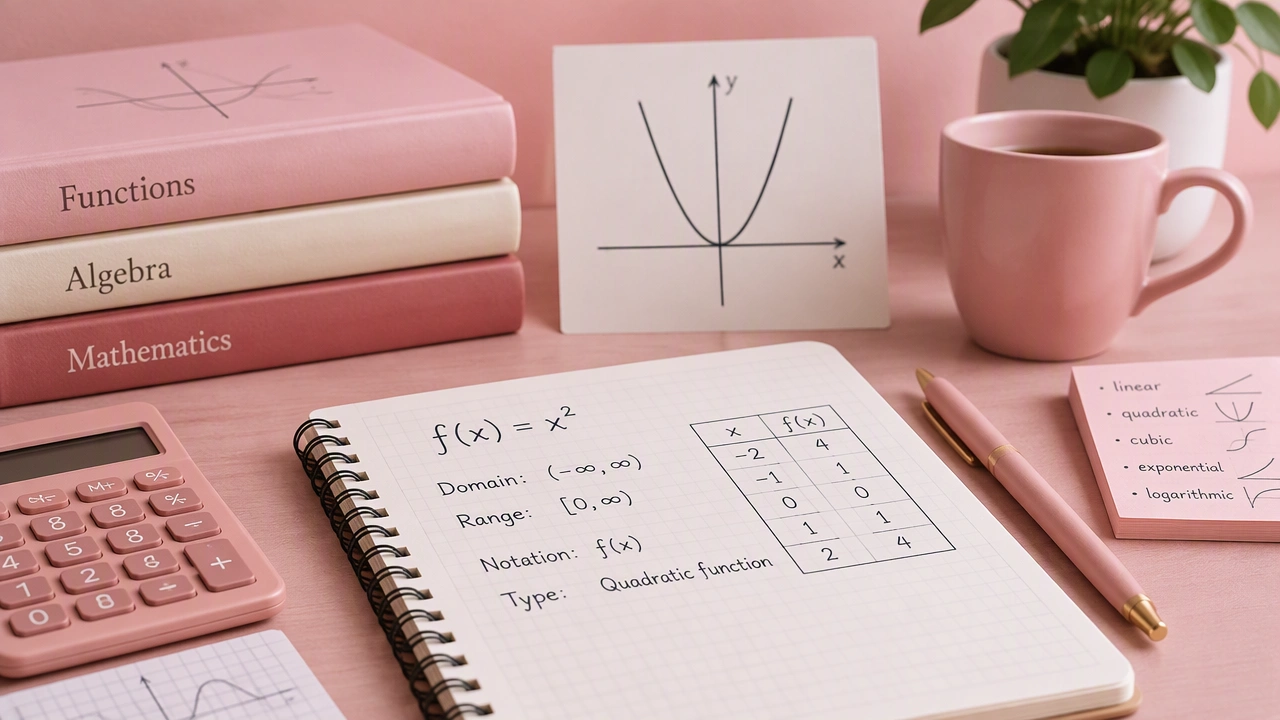
Consider g(x) = x^2. Any real number can be squared, so the domain is all real numbers. The outputs are never negative, so the range is all numbers greater than or equal to zero.
Types of math functions
Functions come in many forms. Recognizing common types helps you choose tools and predict behavior. Here are the core families you will meet first.
Linear functions
A linear function has the form f(x) = mx + b, where m is the slope and b is the y-intercept. Linear functions produce straight-line graphs. They model constant rates, like steady speed or fixed cost plus a per-item charge.
Quadratic functions
A quadratic function has the form f(x) = ax^2 + bx + c with a not equal to zero. The graph is a parabola. Quadratics model situations where a quantity accelerates or decelerates, such as projectile motion or area changes.
Polynomial functions
Polynomials include linear and quadratic functions and extend to higher powers, like f(x) = 3x^4 – 2x^2 + 5. They are smooth and continuous, and they are useful for approximating many real-world curves.
Rational functions
A rational function is a ratio of two polynomials, such as f(x) = (x + 1)/(x^2 – 4). Watch for values that make the denominator zero, since those inputs are excluded from the domain.
Exponential functions
An exponential function has the form f(x) = a b^x with b > 0 and b not equal to 1. Exponential functions model growth or decay, like population increase, radioactive decay, or compound interest.
Logarithmic functions
A logarithmic function is the inverse of an exponential function. For example, if g(x) = log_b(x), then g answers the question: what power of b gives x? Logarithms help solve for time or rate in growth models and compress wide ranges of values.
Trigonometric functions
Functions like sine, cosine, and tangent describe cycles. They model waves, oscillations, and periodic motion in physics, engineering, and signal processing.
Key properties that describe any function
Once you know the type, check a few properties to understand behavior.
- Domain and range: what inputs are allowed and what outputs are possible
- Intercepts: where the graph crosses the x-axis or y-axis
- Increasing or decreasing: where outputs go up or down as inputs increase
- Maximum and minimum: highest or lowest values in a region
- Periodicity: whether the function repeats in regular cycles
- Concavity: whether the graph bends upward or downward
These properties help you sketch graphs, interpret data, and connect the function to a real situation.
Why functions matter
Functions organize thinking. They turn a question about change into a rule you can analyze. In science, functions link variables, such as force and acceleration. In finance, functions connect interest rates and time. In computing, functions map inputs to outputs inside algorithms.
Functions also build bridges between topics. Derivatives measure rates of change of functions. Integrals accumulate values of functions. Probability uses functions to describe distributions. Machine learning uses functions to map features to predictions.
A simple step-by-step approach to learn any function
Use this routine when you meet a new function.
- Write the rule and name the input variable.
- Find the domain by removing inputs that break the rule.
- Compute a few values to see the pattern.
- Sketch a graph or describe the shape in words.
- Identify intercepts, symmetry, and key points.
- Check for asymptotes or undefined points if the rule is a ratio.
- Connect the function to a real example to anchor meaning.
Common mistakes and how to avoid them
Beginners often mix up the rule name f with the output f(x). Remember that f is the function itself, while f(x) is a number you get after plugging in x. Another mistake is ignoring the domain. Always ask whether the input is allowed before simplifying.
A third mistake is assuming all curves are functions. Use the vertical line test: if a vertical line meets the graph at more than one point, the relation is not a function of x. Finally, do not confuse a function with its graph. The function is the rule; the graph is one visual representation.
Practice path for beginners
Start with linear functions to build confidence. Move to quadratics to see curvature. Then explore exponential and logarithmic functions to understand growth and decay. Add trigonometric functions when you need cycles. At each step, connect the algebra to a graph and to a simple real-world story.
Keep a small notebook of rules, domains, and sample values. Over time, you will see that many problems share the same function shapes. That recognition is powerful. It lets you transfer skills from one context to another and makes new topics feel familiar.
Summary
Functions are rules that turn inputs into outputs. They give structure to math and to modeling. By learning notation, domain and range, common types, and key properties, you build a reliable toolkit. With steady practice, the question of what are math functions and how do they work becomes clear: functions are predictable rules that describe relationships, and they are the language we use to make those relationships precise.