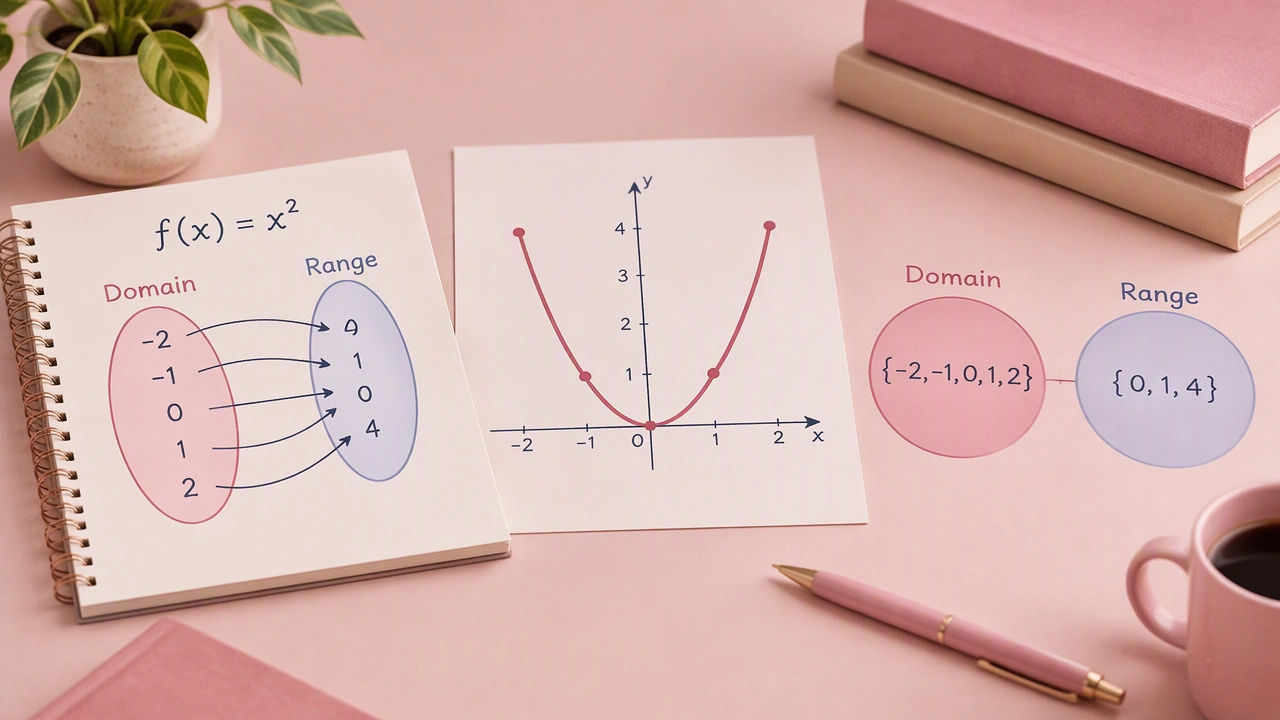
Domain and Range Explained Simply: A Visual Step-by-Step Guide
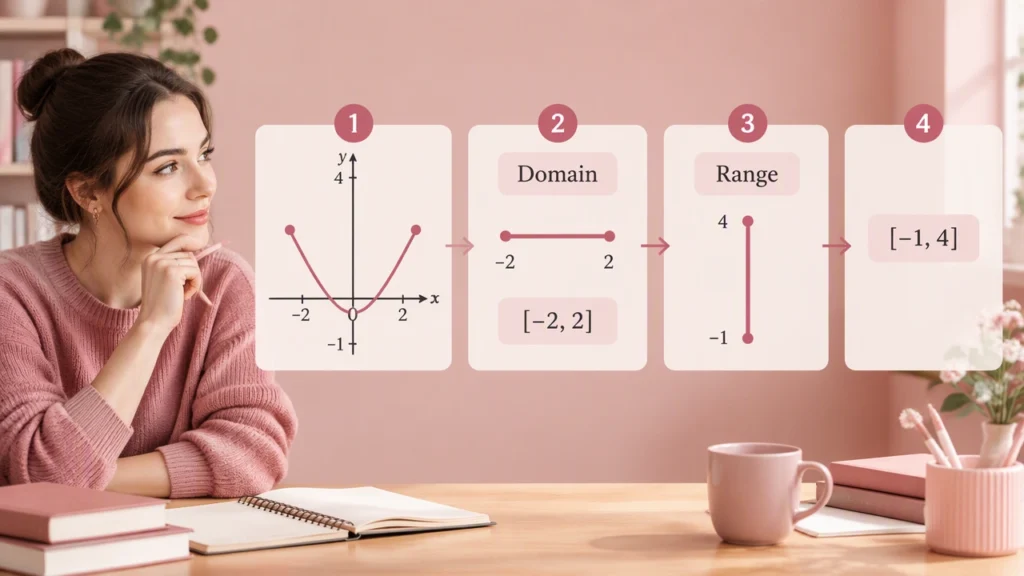
Understanding math functions becomes much easier when you can picture what each function allows and what it produces. The domain describes every input a function accepts, while the range describes every output it can produce. This guide offers a clear, visual walkthrough of how to find domain and range of a function step by step, using simple rules that work for graphs, equations, and tables.
What domain and range mean
Think of a function as a machine. The domain is the set of allowed inputs, usually values of x. The range is the set of possible outputs, usually values of y or f(x). A value belongs to the domain only if the rule can be applied without breaking the conditions of the function. A value belongs to the range only if some allowed input actually produces it.
For example, if a machine adds 3 to its input, then the input 5 belongs to the domain and the output 8 belongs to the range. The domain and range are sets, so they may be intervals, lists, or descriptions such as all real numbers except a particular value.
The visual idea behind the rules
On a graph, the domain is measured along the horizontal axis and the range along the vertical axis. Picture shining a light straight down onto the graph: the shadow on the horizontal axis shows the domain. Then shine the light sideways: the shadow on the vertical axis shows the range.
This simple picture gives two practical checks:
- Domain check: does the graph exist above or below this horizontal position?
- Range check: does the graph reach this vertical height?
Open circles, closed circles, and arrows matter. An open circle excludes the exact endpoint. A closed circle includes it. An arrow means the graph continues in that direction unless another restriction says otherwise.
How to find domain and range of a function step by step
Step 1: Identify the type of function
Start by deciding what kind of function you have. Common types include polynomial functions, square-root functions, rational functions, absolute-value functions, exponential functions, logarithmic functions, and piecewise functions. The type tells you which restrictions to check first.
Step 2: Look for domain restrictions
Most functions are defined for all real numbers, but three restrictions cover many cases:
- Division by zero: exclude inputs that make a denominator equal to zero.
- Even roots: for square roots and other even roots, the expression inside the root must be greater than or equal to zero.
- Logarithms: the input of a logarithm must be strictly greater than zero.
Write each restriction as an inequality, solve it, and keep the values allowed by every condition. If the function has no restrictions, state that the domain is all real numbers.
Step 3: Check the graph or table
If you have a graph, scan from left to right. The leftmost and rightmost points define the horizontal span. If the graph continues with arrows, the span may extend forever. If there is a gap, remove that horizontal section from the domain.
If you have a table, list all given inputs. The domain is exactly the set of inputs shown, unless the table is described as a sample of a larger pattern.
Step 4: Find the range from outputs
For a table, collect the output values and remove duplicates. For a graph, scan from bottom to top. The lowest and highest points show the vertical span. Remember that the graph must actually reach a height for that height to belong to the range.
For an equation, it often helps to sketch a quick graph or analyze the function’s behavior. Ask where the outputs start, whether they increase or decrease, and whether they approach a boundary without reaching it.
Step 5: Write the answer clearly
Use interval notation or set notation consistently. For example, the interval from 2 to 5 including both endpoints is written as [2, 5]. If 2 is excluded, use (2, 5]. If a value is forbidden, write it as an exception, such as all real numbers except 0.
Simple rules for common functions
Polynomial functions
Polynomials, including linear, quadratic, and cubic functions, accept every real number. Their domain is all real numbers. The range depends on the shape. A line with nonzero slope has range all real numbers. A quadratic that opens upward has a minimum value, so its range starts at that minimum and continues upward.
Square-root functions
For a square root, set the expression under the root greater than or equal to zero and solve. That gives the domain. The square-root output is never negative, so the range begins at 0 and increases, unless the function has been shifted or reflected.
Rational functions
For a rational function, set the denominator equal to zero and exclude those inputs. The range requires more care because the graph may approach a horizontal boundary. Look for horizontal asymptotes and any values the graph never reaches.
Absolute-value functions
Absolute-value functions accept all real numbers. Their graph is V-shaped, so the range starts at the vertex and extends upward if the vertex is the lowest point. If the function is reflected, the range extends downward instead.
Exponential and logarithmic functions
An exponential function with a positive base has domain all real numbers and range values greater than zero. A logarithmic function has domain values greater than zero and range all real numbers, because the graph grows slowly but continues without a fixed upper limit.
A worked visual example
Consider a graph that begins at the closed point (1, -2), rises steadily, and ends at the open point (5, 4). The horizontal span includes 1 but stops just before 5, so the domain is [1, 5). The vertical span includes -2 and reaches values just below 4, so the range is [-2, 4).
Now imagine the same graph with arrows at both ends instead of endpoints. The horizontal and vertical spans extend forever, so both domain and range become all real numbers. Changing only the endpoints changes the answer, which is why symbols and arrows deserve close attention.
Common mistakes to avoid
- Confusing the horizontal axis with the vertical axis.
- Keeping a value that makes a denominator zero.
- Forgetting that a square-root expression must be nonnegative.
- Treating an asymptote as a value the graph reaches.
- Listing outputs that no allowed input actually produces.
Practice the process
Use the same sequence every time: identify the function, check algebraic restrictions, inspect the graph or table, determine the vertical span, and write the result in clear notation. With practice, the visual picture becomes automatic. You will see the horizontal shadow for the domain and the vertical shadow for the range, then confirm the details with simple rules. This steady method makes domain and range questions calm, organized, and predictable.